Exploring the Capabilities of Virtual Reality in Education
Welcome to the future of education! Virtual reality, once a concept reserved for science fiction movies, has now become a reality in both technology and education. This emerging form of technology has the potential to completely transform the way we learn and experience education. With its highly immersive and interactive nature, virtual reality has a plethora of capabilities that allow for a more engaging and effective learning experience. In this article, we will explore the various capabilities of virtual reality in education and how it is revolutionizing the traditional learning process.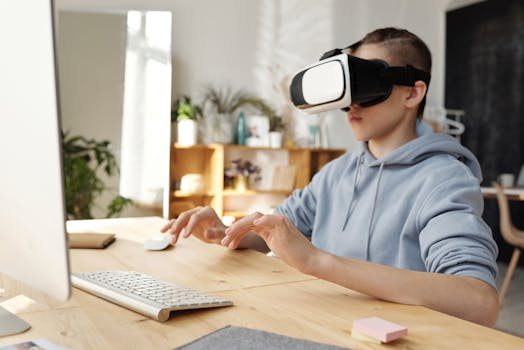
The Rise of Virtual Reality in Education
Virtual reality, also known as VR, has been gaining popularity in recent years, especially in the field of education. It involves the use of computer-generated simulations to create a realistic and immersive learning environment. Students are equipped with virtual reality headsets that transport them to a 3D world where they can interact with and manipulate objects. This technology is not only appealing to students, but it also offers a wide range of benefits in the learning process.
Enhanced Engagement and Immersion
One of the key capabilities of virtual reality in education is its ability to provide an immersive learning experience. Traditional learning methods can often be dull and passive, making it challenging for students to stay engaged. With VR, students can actively participate in the learning process, making it more enjoyable and effective. They can explore and manipulate objects in a virtual world, making the learning experience more interactive and hands-on.
Improved Retention and Understanding
The immersive nature of virtual reality also enhances students’ ability to retain information and understand complex concepts. Studies have shown that interactive and experiential learning has a higher retention rate than traditional teaching methods. With VR, students can visualize and experience concepts in a more tangible way, making it easier for them to grasp and retain information.
Personalized Learning
Virtual reality also has the capability to personalize learning for each student. With its advanced technology, VR can adapt to individual learning styles, pace, and needs. This enables students to learn at their own pace and in a way that suits them, making the learning process more efficient and effective.
Applications of Virtual Reality in Education
The potential applications of VR in education are vast and are continuously expanding. From science and history to art and language, virtual reality can be used in various subjects and fields. Here are just a few examples of how VR is being used in education:
Exploring Historical Sites and Events
Virtual reality allows students to travel back in time and experience historical events and places. They can explore ancient ruins, visit museums and galleries, and even witness significant moments in history, all from the comfort of their classroom. This immersive experience brings history to life and makes it more engaging and memorable for students.
Simulations and Experiments in Science
VR has the potential to create highly realistic simulations for scientific experiments that would otherwise be dangerous or impossible in a traditional classroom setting. Students can also explore different environments, such as a rainforest or the depths of the ocean, to better understand the natural world.
Language Learning
Virtual reality can also be used to facilitate language learning. Students can immerse themselves in a virtual environment where they are constantly exposed to the language they are studying. This allows for a more immersive and practical learning experience, making it easier for students to learn and retain the language.
Overcoming Challenges with Virtual Reality in Education
While virtual reality has numerous capabilities and potential applications in education, there are also some challenges that need to be addressed. The costs of VR equipment may be a barrier for some schools, and there may also be concerns about the impact on students’ physical and mental health. However, with advancements in technology and increased accessibility, these challenges are steadily being overcome.
Conclusion
In conclusion, virtual reality is paving the way for a more engaging, immersive, and personalized learning experience in education. By exploring its various capabilities, we can see how VR can revolutionize the traditional teaching methods and enhance students’ learning outcomes. As technology continues to advance, we can expect to see more innovative and exciting uses of virtual reality in education, bringing us one step closer to the future of learning.